
It’s hard to believe, but come Thursday, the third of this year’s four men’s major championships will be underway. The 2025 U.S. Open returns to Oakmont Country Club for a record 10th time. First contested there in 1927—when Scotland’s Tommy Armour defeated Harry Cooper in a playoff—Oakmont has long been one of the toughest tests in golf.
The last U.S. Open at Oakmont came in 2016, when Dustin Johnson, now a LIV golfer, claimed victory at four under par—one of just four players to finish under par that week.
In his press conference this week, Johnson spoke on his experience of Oakmont being the hardest course he has ever played;
“I’ve played some hard courses, but it all depends on the conditions.
“This one’s hard, no matter what. Soft, firm, windy, no wind.”
The U.S. Open has always been known as golf’s toughest test—even for professionals who often make the game look effortless. Since 1930, only 40 percent of U.S. Opens have been won with a score of even par or higher.
Embed from Getty ImagesThat level of difficulty divides opinion. Some fans love watching the world’s best tear apart courses with birdies and eagles. Others believe there should be at least one week a year when the pros are pushed to their absolute limits—where par truly means something.
Then there’s the argument from the weekend golfer: we see enough struggles in our own games and those of our mates. Watching birdies and eagles on TV isn’t just exciting—it’s inspiring. It shows what’s possible.
The rough.
At Oakmont, though, scoring will be anything but easy. The rough is brutal. Miss the fairway, and the best—and often only—option may be hacking out with a wedge. It’s the kind of “take your medicine” golf that many amateurs know all too well.
Photos and clips from the course show rough so thick the ball practically vanishes. Not ideal for the players—but not exactly unfamiliar for the rest of us. I’ve hit tee shots that felt perfect, swore they were in the fairway… and never saw them again. At least this week’s pros will have thousands of fans, marshals, and cameras to help with the search.
The greens.
Green speed, measured using a Stimpmeter, indicates how quickly a ball rolls on a putting green. The resulting “stimp rating” helps determine the difficulty of the greens — higher numbers signify faster greens, while lower numbers indicate slower surfaces.
The average green speed on the PGA Tour typically ranges between 11 and 12. However, the USGA has announced that this year’s green speeds will be running between 14.5 and nearly 15 feet on the Stimpmeter.
Noted golf course architect Tom Doak has criticised the club for going too far with the speed of the greens. In his book, The Confidential Guide to Golf Courses, he wrote:
“I’m disappointed that the club has placed such emphasis on excessively fast greens; their contour would hold plenty of interest without it, but the attention they’ve given to speed has led other courses to overdo it, too.”
The par threes.
The 8th hole at Oakmont is a 289-yard par three. For those familiar with golf, that’s essentially a short par four. From professionals and club members to amateurs, there’s a general consensus that the best par threes—if not the best in the world—are shorter and demand pinpoint accuracy with a wedge or short iron.
However, the USGA and Oakmont have set this hole up at 289 yards, and players during practice rounds have been using drivers off the tee. While I fully support course setups that truly test a player’s skill, this seems like a step too far—or rather, a couple of hundred yards too long.
By comparison, the shortest par three at Oakmont is 182 yards—not exactly short, but a more familiar and suitable length for tour players. It’s also interesting to note the wide range in par fours: the 17th hole is the shortest at 312 yards, which might soon be reconsidered as a par three, while the longest, the 15th, stretches to 507 yards. That’s a 195-yard difference—something it will be fascinating to compare in scoring this week.
From a spectator’s perspective, this setup also loses some of the charm that makes par threes so special. The beauty of a par three lies in being able to watch the entire hole, from tee to green, in one view. At 289 yards, however, that experience is lost unless you’re well equipped with binoculars.
The players.
With so much focus on the course conditions and setup ahead of the U.S. Open, it’s easy to overlook the main protagonists this week.
World number one Scottie Scheffler and world number two Rory McIlroy arrive with contrasting recent form. Scheffler, fresh from winning the PGA Championship, also claimed the CJ Cup earlier in the season and most recently triumphed at the Memorial Tournament. He finished tied fourth at the Charles Schwab Challenge.
McIlroy, meanwhile, has struggled to maintain momentum since his memorable Masters victory. His best result in four events since Augusta was a tied seventh at the Truist Championship. Most notably, he missed the cut at last week’s Canadian Open, finishing nine over par after two rounds.
One player to watch this week is the two-glove sensation Aaron Rai. With so much attention on the punishing rough at Oakmont, accuracy off the tee and finding the fairway will be crucial to success.
Rai currently leads the PGA Tour in driving accuracy, having hit an impressive 492 out of 670 fairways — a remarkable 73.43%. His closest challenger is former Open and PGA championship winner Collin Morikawa, who sits just behind at 72.87%. Morikawa’s major-winning experience could prove invaluable, making this an intriguing battle to follow.
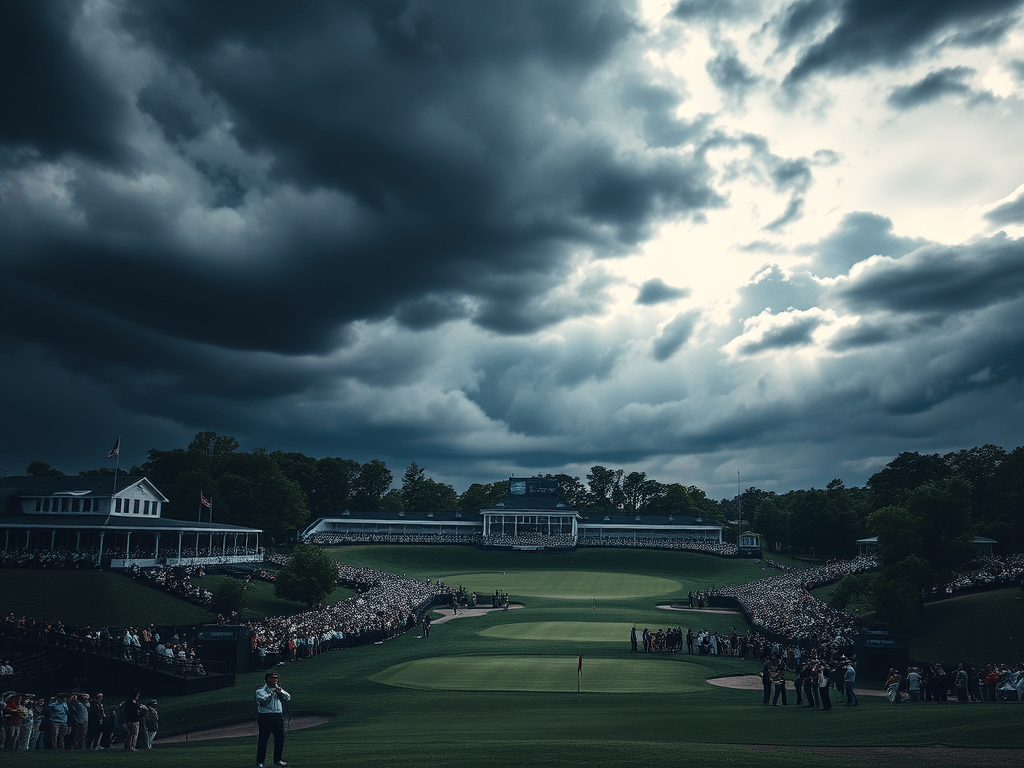
Embed from Getty ImagesAs the U.S. Open gets underway at the formidable Oakmont Country Club, players will be tested like never before. From the lightning-fast greens to the brutally thick rough and daunting course setup, it promises to challenge every aspect of their game.
Yet, amid the course conditions and tactical battles, it’s the skill, resilience, and precision of the world’s best—whether it’s Scottie Scheffler defending his major crown, Rory McIlroy seeking a return to form, or accurate drivers like Aaron Rai—that will ultimately decide who lifts the trophy.
This week, golf fans are in for a thrilling spectacle where history could be made, and legends will be tested.



 Swing and Hope
Leave a comment